


As a crypto native, I never expected to consider gold. Let alone use it as part of my savings, trading and cash flow strategies in decentralized finance. But the asymmetrical opportunity gold presents heading into 2026 makes ignoring it imprudent. Before examining how gold can be used to grow holdings or enhance overall portfolio performance, it is worth understanding why prices are rising and why the metal may continue to set record highs.
Why Is The Gold Price Climbing?
At first glance, the gold market appears complex. Strip it back, however, and the price dynamic comes down to a single imbalance: how much gold is mined each year versus how much is bought. Viewed over the past five years, that imbalance of supply and demand becomes clear and so does the source of the additional buying pressure.
Global mine production has been broadly flat, averaging between 3,200 and 3,700 tonnes annually from 2020 through 2025. Over the same period, total demand has exceeded 4,000 tonnes a year. Jewelry and industrial use account for roughly 2,300 tonnes annually, while investment demand from retail and institutional buyers via exchange traded funds, physical gold bars and coins adds another 1,200 tonnes. Together, those categories effectively absorb the entire annual supply.
That calculation excludes the most consequential marginal buyer: central banks.
Central bank demand is where the imbalance widens. Central banks purchased just over 200 tonnes of gold in 2020. By 2022, buying surged and has since exceeded 1,000 tonnes a year. This structural increase in demand, layered on top of an already tight market, is the key force pushing gold prices to record highs.
Why Are Central Banks Buying Gold?
In 2022, Russia’s invasion of Ukraine triggered one of the most consequential financial precedents in decades. The US and its allies froze roughly $300 billion of Russia’s central bank reserves held abroad much of it in dollars, euros and other Western currencies. The move was widely applauded in the West as a powerful sanctions tool.
Inside central banks globally, it had a very different effect.
The episode underscored a hard reality: foreign exchange reserves held within the US-led financial system including assets settled through SWIFT are not politically neutral. They can be immobilized with the stroke of a pen. For reserve managers, the question quickly became unavoidable: why hold US Treasuries or other Western sovereign debt if access to those assets can be revoked?
The response has been a shift back toward reserve assets that carry no counterparty risk. Gold fits that requirement. It is physical, universally accepted and sits outside the reach of sanctions when held domestically.
The result has been a structural surge in central bank demand. Central banks bought more than 1,000 tonnes of gold in 2022, repeated that pace in 2023 and 2024, and are on track for another record-breaking year in 2025 potentially exceeding last year’s purchases.
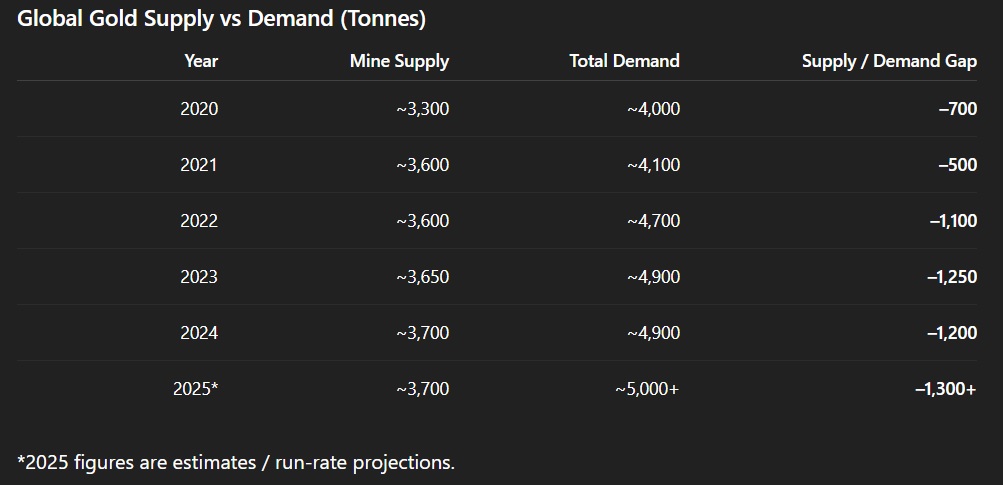
Sources for gold annual supply and demand numbers; World Gold Council
This is not speculative demand and it is not cyclical. It reflects a reassessment of geopolitical risk and reserve security. And unlike ETF flows or retail buying, central-bank demand tends to be persistent, price-insensitive and long term adding sustained pressure to an already tight gold market.
Onchain Gold Strategies
Now you have a clear picture of who is buying gold and why. The only question left is how you can profit from the gold investment as well while doing everything onchain. The most basic and easy thing you could do is dollar cost average into gold stablecoins and hold. The 2 biggest gold backed tokens are currently XAUt and PAXG. Holding gold onchain vs an gold ETF, saves 0.09%-0.60% per year in fees.
Buying and holding, however, isn’t why investors are here. They’re looking for DeFi strategies that can expand gold holdings or generate cash flow as bullion appreciates. Two approaches stand out. The first is providing liquidity, allowing investors to earn fees while maintaining exposure to gold. The second involves borrowing against gold to exploit interest rate arbitrage.
Earn Yield On Gold via LP
Investors only seeking gold yield can earn trading fees as a liquidity provider in decentralized finance by supplying liquidity in gold correlated pairs such as XAUt/PAXG on decentralized exchanges. This strategy could return 1-3% APR in gold terms.
Leverage Gold: Produce Cash Flow via Interest Rate Arbitrage
Investors seeking to produce cash flow from gold holdings. The safest strategy is interest rate arbitrage. Onchain there are 3 reliable lending/borrowing protocols to leverage the largest gold backed tokens; Aave, Morpho, and Fluid. Borrowing cost average interest rate range between 3% to 7% APR. Check out the stablecoin yield page for available strategies that would suit your risk profile to apply to your portfolio.