

For decades, the standard investment portfolio has followed a simple formula: 60% stocks and 40% bonds. The idea was straightforward. Stocks provided growth, while bonds added stability and income. Together, the 60/40 portfolio became the gold standard for long-term investing.
But investing has changed dramatically over the last fifteen years.
Interest rates stayed near historic lows for years. Inflation returned in a major way after 2020. Bonds, which were once considered the “safe” side of a portfolio, experienced some of their worst performances in modern history. At the same time, digital assets particularly Bitcoin evolved from a niche internet experiment into a trillion dollar asset class held by institutions, ETFs, corporations, and even governments.
That shift has caused many investors and financial analysts to rethink the traditional 60/40 strategy. Increasingly, the conversation is no longer about whether crypto belongs in a portfolio, but how much.
A growing number of investors now believe that crypto deserves roughly 10% of a modern portfolio allocation. Not 50%. Not 100%. But enough exposure to potentially benefit from the upside of a rapidly growing asset class without taking excessive risk.
The key question becomes: where does that 10% come from?
Why the Traditional 60/40 Portfolio Is Being Challenged
The original purpose of the 60/40 portfolio was diversification. Stocks and bonds historically moved differently from each other, helping smooth returns during periods of volatility.
The problem is that bonds are no longer delivering the same benefits they once did.
For decades, investors could rely on bonds for predictable income and protection during market downturns. But inflation has changed the equation. When inflation rises faster than bond yields, investors actually lose purchasing power holding too much fixed income.
At the same time, younger investors are increasingly focused on growth assets. Technology stocks, private equity, and crypto have become major drivers of wealth creation over the last decade.
Bitcoin, in particular, has emerged as a unique asset. Some view it as digital gold. Others see it as a hedge against monetary inflation. Regardless of the narrative, the numbers are difficult to ignore. Bitcoin has significantly outperformed nearly every major asset class over long time horizons despite extreme volatility.
That is why many modern portfolio discussions now include a 10% crypto allocation.
The important distinction is that crypto should complement a portfolio not replace traditional investing entirely.
Where the 10% Crypto Allocation Should Come From
The right allocation depends heavily on age, risk tolerance, and investment timeline.
Younger investors generally have more time to recover from volatility, which means they can afford to reduce bond exposure more aggressively. Older investors approaching retirement typically prioritize capital preservation and income, meaning they may want to trim both stocks and bonds more conservatively.
Here is one way to think about adding a 10% crypto allocation by age group.
Investors in Their 20s and 30s
Younger investors often have long time horizons and can tolerate higher volatility. In many cases, bonds already make up a relatively small percentage of their portfolio.
A possible allocation could look like this:
- 70% stocks
- 20% bonds
- 10% crypto
In this scenario, most of the crypto allocation comes from reducing bonds rather than cutting growth assets. Since younger investors are decades away from retirement, they may benefit more from higher growth opportunities.
Investors in Their 40s
Investors in their 40s are often balancing growth with increasing stability. Retirement is still far away, but risk management becomes more important.
A balanced allocation may look like:
- 60% stocks
- 30% bonds
- 10% crypto
This keeps the portfolio diversified while still introducing meaningful exposure to Bitcoin and digital assets.
Investors in Their 50s and 60s
As retirement approaches, preserving wealth becomes increasingly important. Investors may still want crypto exposure, but with a more conservative approach.
A potential allocation could be:
- 50% stocks
- 40% bonds
- 10% crypto
This allows investors to maintain income producing and defensive assets while still participating in potential upside from Bitcoin.
The important takeaway is that the crypto allocation does not need to come entirely from stocks. In many cases, bonds are the portion most likely to be reduced because they currently offer lower real returns relative to inflation.
Why Bitcoin Should Be 98–100% of Your Crypto Allocation
One of the biggest mistakes new crypto investors make is confusing Bitcoin with the broader crypto market.
Thousands of cryptocurrencies exist today, but very few have demonstrated long-term staying power. Many projects experience massive hype cycles before eventually collapsing or fading into irrelevance.
Bitcoin is different.
Bitcoin has the longest track record, the strongest network effect, the highest institutional adoption, and the clearest investment thesis. It is decentralized, scarce, globally recognized, and increasingly viewed as a reserve digital asset.
For most investors, Bitcoin should make up 98–100% of the crypto allocation.
If crypto represents 10% of a portfolio, that means approximately 9.8% to 10% should be Bitcoin.
Why such a heavy concentration?
Because Bitcoin has historically outperformed most alternative cryptocurrencies over long periods once adjusted for survivorship bias and risk. While some altcoins temporarily outperform during speculative bull markets, very few maintain their position over multiple market cycles.
Bitcoin also benefits from factors many altcoins do not have:
- Institutional ETF adoption
- Corporate treasury adoption
- Greater liquidity
- Regulatory clarity relative to smaller tokens
- Lower long-term survivorship risk
- Stronger brand recognition
For long-term investors focused on wealth preservation and appreciation, Bitcoin has increasingly become the foundational crypto asset.
The 4-Year Dollar Cost Averaging Case for Bitcoin
One of the strongest arguments for Bitcoin is the historical performance of long-term dollar cost averaging (DCA).
DCA is the strategy of investing a fixed amount consistently over time regardless of price. Instead of trying to perfectly time the market, investors buy regularly during both bull and bear markets.
Bitcoin’s volatility can be intimidating in the short term. But historically, investors who consistently bought Bitcoin over rolling four year periods have often seen strong results.
Why four years?
Because Bitcoin historically moves in market cycles tied to its halving events, which occur roughly every four years. While past performance never guarantees future returns, the four year cycle has repeatedly shown periods of expansion followed by deep corrections and eventual recovery.
For example:
- Investors who bought Bitcoin weekly through major crashes including 2018, 2020, and 2022 often ended up profitable if they continued accumulating through the full cycle.
- DCA reduces emotional decision making.
- Investors avoid the pressure of trying to buy the exact bottom.
- Volatility becomes less dangerous when viewed over longer time horizons.
The key lesson is that Bitcoin rewards patience more than prediction.
Many investors who panic sold during crashes missed the recoveries that followed. Meanwhile, disciplined DCA investors benefited from accumulating during periods of fear. Read the full data driven article on the Bitcoin DCA strategy.
This is another reason Bitcoin deserves the overwhelming majority of a crypto allocation. It has demonstrated resilience through multiple boom and bust cycles while many competing projects disappeared entirely.
Why a Small “Moonshot” Allocation Can Still Make Sense
Although Bitcoin should dominate a crypto portfolio, there is still room for a small speculative allocation.
This is where the remaining 1–2% of the crypto allocation can come into play.
For example:
If crypto makes up 10% of your total portfolio, you might allocate:
- 98% of crypto to Bitcoin
- 2% of crypto to speculative assets
That means only 0.2% of your total portfolio is dedicated to high-risk bets.
This approach allows investors to participate in potential breakout opportunities without jeopardizing long-term financial stability.
Speculative investments may include:
- Emerging blockchain projects
- AI-related crypto assets
- Infrastructure protocols
- Gaming or tokenization platforms
Most of these projects will likely fail over time. That is simply the reality of speculative investing.
But if one significantly outperforms, the upside can meaningfully impact returns despite the small allocation size.
The psychology here is important.
A controlled speculative allocation helps investors avoid overexposing themselves to risky assets while still satisfying the desire to participate in innovation and potential outsized gains.
If the moonshot succeeds, the allocation was worth it.
If it fails, the damage is minimal because it represented only 1–2% of the crypto portion of the portfolio not the entire portfolio itself.
Comparing Portfolio Structures
To understand how crypto changes portfolio construction, it helps to compare several examples.
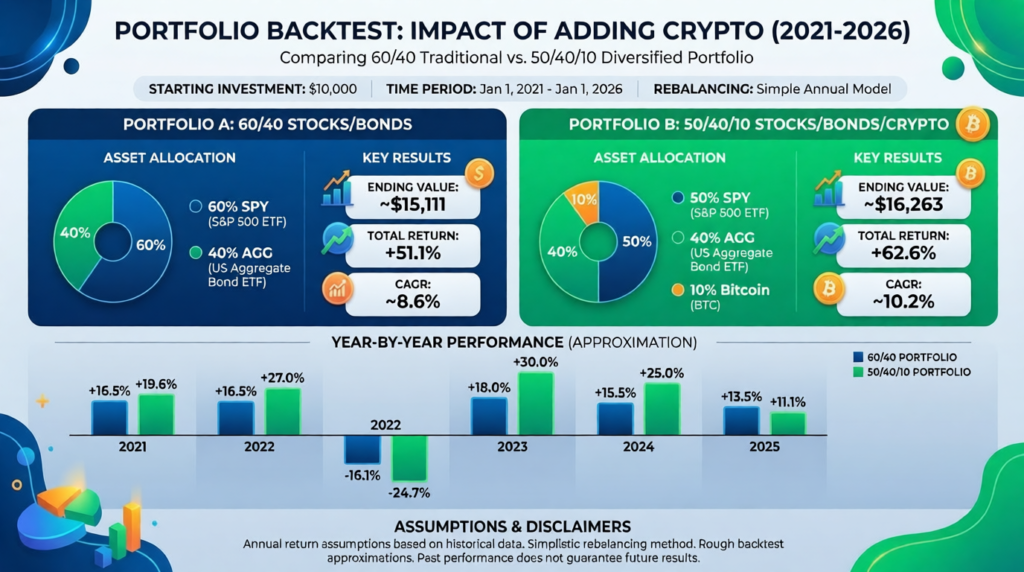
Traditional 60/40 Portfolio
- 60% stocks
- 40% bonds
- 0% crypto
This portfolio prioritizes traditional diversification and lower volatility but may struggle to keep pace with inflation and modern growth trends.
60/30/10 Portfolio
- 60% stocks
- 30% bonds
- 10% crypto
This is likely the most balanced modern approach for many investors. It preserves strong stock exposure while introducing Bitcoin as a long-term growth asset.
50/40/10 Portfolio
- 50% stocks
- 40% bonds
- 10% crypto
This structure may appeal to more conservative investors nearing retirement who still want exposure to Bitcoin’s upside without dramatically increasing portfolio risk.
55/35/10 Portfolio
- 55% stocks
- 35% bonds
- 10% crypto
This allocation sits in the middle, balancing growth, income, and alternative assets in a more modern diversified strategy.
60/40 vs 50/40/10 Portfolio Backtest
Final Thoughts
Crypto investing does not need to be extreme.
Investors do not need to sell everything and go all-in on digital assets. But ignoring Bitcoin entirely may become increasingly difficult as adoption continues growing globally.
A 10% crypto allocation offers a middle ground.
It is large enough to potentially impact long-term returns, but small enough that the portfolio is still grounded in traditional investing principles.
The most important factor is discipline.
Bitcoin has historically rewarded long-term conviction, consistent accumulation, and patience through volatility. Investors who treat crypto as a strategic allocation rather than a short-term gamble are often better positioned to manage risk and stay invested during market swings.
For most investors, the formula may ultimately be simple:
- Keep the majority of your portfolio in traditional assets.
- Allocate around 10% to crypto.
- Make Bitcoin the foundation of that allocation.
- Keep speculation small and controlled.
That approach allows investors to participate in one of the most important emerging asset classes of the modern era without abandoning the core principles of diversification and risk management.