
I. Introduction
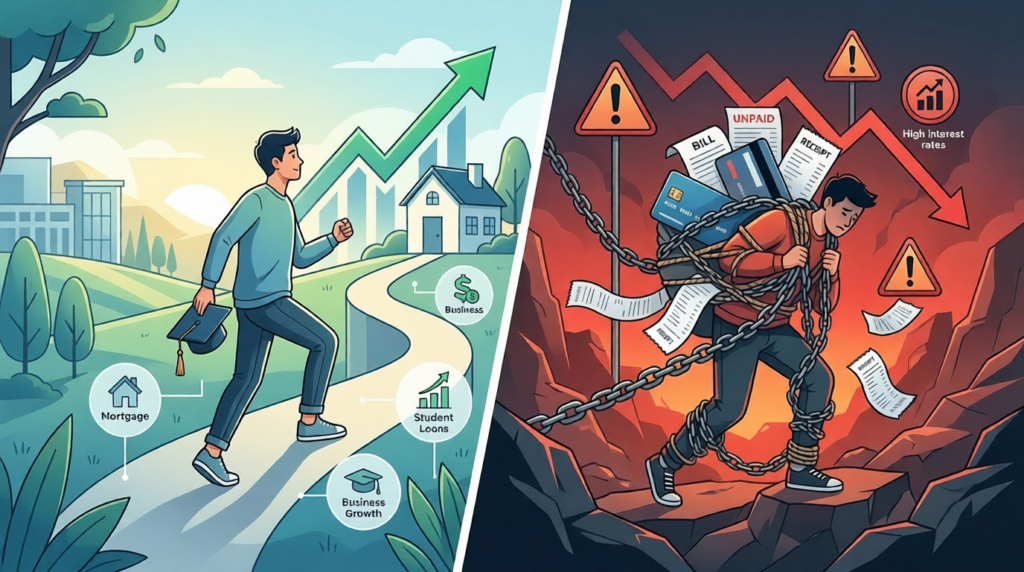
Debt has a strange reputation. On one hand, it’s often blamed for financial stress, sleepless nights, and long-term money struggles. On the other, it’s a powerful tool that can help people build wealth, invest in their future, and unlock opportunities they couldn’t otherwise afford. This paradox makes debt one of the most misunderstood aspects of personal finance.
In today’s world, debt is almost unavoidable. From student loans to mortgages to credit cards, borrowing money has become a normal part of life. Yet, many people enter into debt without fully understanding how it works or how it can work for or against them.
At its core, debt is simply borrowing money with the agreement to repay it, usually with interest. But not all debt is created equal. Some forms of debt can help you grow financially, while others can quietly drain your resources and limit your future options.
The key to financial health isn’t avoiding debt entirely it’s understanding the difference between “good” and “bad” debt, and using that knowledge to make smarter decisions.
II. What Is Debt? (The Basics)
A. Definition of Debt
Debt is money borrowed from a lender with the expectation that it will be paid back over time, typically with interest. The lender could be a bank, credit union, government, or even an individual.
B. Key Components of Debt
Understanding debt starts with knowing its core elements:
- Principal: The original amount borrowed.
- Interest Rate: The cost of borrowing money, expressed as a percentage.
- Fixed: Stays the same over time.
- Variable: Can change based on market conditions.
- Term: The length of time you have to repay the loan.
- Monthly Payments: Regular payments that include principal and interest.
- Fees and Penalties: Late fees, origination fees, or prepayment penalties.
C. Common Types of Debt
Most people encounter these forms of debt:
- Credit cards
- Student loans
- Mortgages
- Auto loans
- Personal loans
Each type serves a different purpose and carries different risks.
III. The Concept of Good vs. Bad Debt
A. Why the Distinction Exists
Debt itself isn’t inherently good or bad it’s a financial tool. Like any tool, its value depends on how it’s used. Some debt helps you build wealth or increase your earning potential, while other debt simply funds short-term consumption.
The distinction also comes down to opportunity cost what you gain (or lose) by choosing to borrow money.
B. The Core Criteria
To determine whether debt is “good” or “bad,” consider:
- Does it generate value or income?
- Does it appreciate or depreciate over time?
- Is it manageable relative to your income?
- What are the interest rate and repayment terms?
IV. What Is Good Debt?
A. Definition
Good debt is typically used to acquire assets or opportunities that can increase your net worth or earning potential over time.
B. Characteristics of Good Debt
- Lower interest rates
- Potential for long-term return
- Supports wealth building
- Predictable repayment structure
C. Common Examples
1. Student Loans
Education is often seen as an investment in your future income. A degree or certification can significantly increase earning potential.
Risks:
- Taking on too much debt
- Choosing a low-return field
- Underemployment after graduation
2. Mortgages
A mortgage allows you to purchase a home, which may appreciate over time. It also builds equity as you pay it down.
Benefits:
- Long-term asset ownership
- Potential property value growth
- Stability compared to renting
3. Business Loans
Starting or expanding a business often requires capital. If successful, the return can far exceed the cost of the loan.
Risks:
- Business failure
- Cash flow issues
- Market uncertainty
4. Strategic Investments
Some experienced investors use borrowed money to invest in assets like real estate or stocks. This is known as leveraging.
Note: This strategy carries higher risk and is not suitable for beginners.
D. When “Good Debt” Turns Bad
Even traditionally “good” debt can become harmful if mismanaged:
- Borrowing more than you can afford
- Investing in low return opportunities
- Accepting high interest rates
- Economic downturns reducing returns
V. What Is Bad Debt?
A. Definition
Bad debt is typically used for consumption purchases that do not generate long-term value or income.
B. Characteristics of Bad Debt
- High interest rates
- Rapid depreciation
- No income generating potential
- Encourages impulsive spending
C. Common Examples
1. Credit Card Debt
Credit cards can be useful tools, but carrying a balance often leads to high interest charges.
Why it’s risky:
- High APRs
- Compounding interest
- Easy to overspend
2. Payday Loans
These short-term loans come with extremely high fees and are often difficult to repay.
Major concern:
- Debt cycle trap
3. High-Interest Personal Loans
When used for non-essential purchases, these loans can quickly become a burden.
4. Auto Loans (Contextual)
Cars lose value quickly, making them depreciating assets.
Reality:
- Necessary for many people
- Often overpriced relative to income
VI. The Gray Area: Debt That Depends
Not all debt fits neatly into “good” or “bad” categories.
A. Auto Loans
A car may be essential for commuting to work, making it a practical necessity. However, financing a luxury vehicle beyond your means shifts it toward bad debt.
B. Student Loans
A degree in a high demand field may justify the cost, while expensive programs with low earning potential may not.
C. Mortgages
Buying a modest, affordable home can build wealth. Overextending yourself on an expensive property can create financial strain.
D. Buy Now, Pay Later (BNPL)
These services offer convenience but can encourage overspending if not carefully managed.
VII. The Cost of Debt
A. Interest and Compounding
Interest is the price you pay for borrowing money. Over time, compounding can significantly increase the total amount owed.
B. Opportunity Cost
Money spent on debt payments could have been invested elsewhere, potentially generating returns.
C. Psychological Impact
Debt can affect mental health, leading to:
- Stress
- Anxiety
- Decision fatigue
D. Credit Score Implications
Debt plays a major role in your credit score:
- Payment history: On-time payments improve your score
- Credit utilization: High balances hurt your score
- Length of history: Longer credit history helps
VIII. How to Evaluate Any Debt
A. Key Questions to Ask
Before taking on debt, ask:
- Will this increase my income or net worth?
- Can I comfortably afford the payments?
- What is the total cost over time?
- Are there better alternatives?
B. Debt-to-Income Ratio (DTI)
DTI measures how much of your income goes toward debt payments.
Why it matters:
- Lenders use it to assess risk
- High DTI can limit borrowing options
C. Interest Rate Benchmarks
While “high” and “low” vary, general guidelines:
- Low: Typically below 5–7%
- Moderate: Around 8–15%
- High: Above 15%
IX. Strategies for Managing Debt
A. Prioritization Methods
Avalanche Method
- Pay off highest-interest debt first
- Saves money over time
Snowball Method
- Pay off smallest balances first
- Builds motivation through quick wins
B. Refinancing and Consolidation
- Lower interest rates
- Combine multiple debts into one payment
C. Budgeting for Debt Repayment
- Track income and expenses
- Allocate funds specifically for debt
- Avoid unnecessary spending
D. Avoiding New Bad Debt
- Build an emergency fund
- Practice mindful spending
- Limit reliance on credit
X. When Debt Can Be Beneficial
Debt can be a strategic tool when used wisely:
- Building credit history
- Accessing opportunities (education, business, housing)
- Inflation advantage: Fixed-rate debt becomes cheaper over time as money loses value
XI. Warning Signs of Dangerous Debt
Watch for these red flags:
- Only making minimum payments
- Increasing balances over time
- Using credit for essentials
- Repeated borrowing cycles
These patterns often indicate deeper financial issues.
XII. Practical Tips for Readers
- Use debt intentionally, not impulsively
- Compare lenders and terms carefully
- Always read the fine print
- Track all debts in one place
- Seek professional advice when necessary
Small decisions around debt can have long-term consequences.
XIII. Conclusion
Debt is not inherently good or bad it’s a tool. When used strategically, it can help you build wealth, invest in your future, and achieve major life goals. When misused, it can become a heavy burden that limits your financial freedom.
The difference lies in how you approach it.
By understanding the types of debt, evaluating their true cost, and making informed decisions, you can take control of your financial future. With the right mindset and knowledge, debt becomes less of a trap and more of an opportunity.