
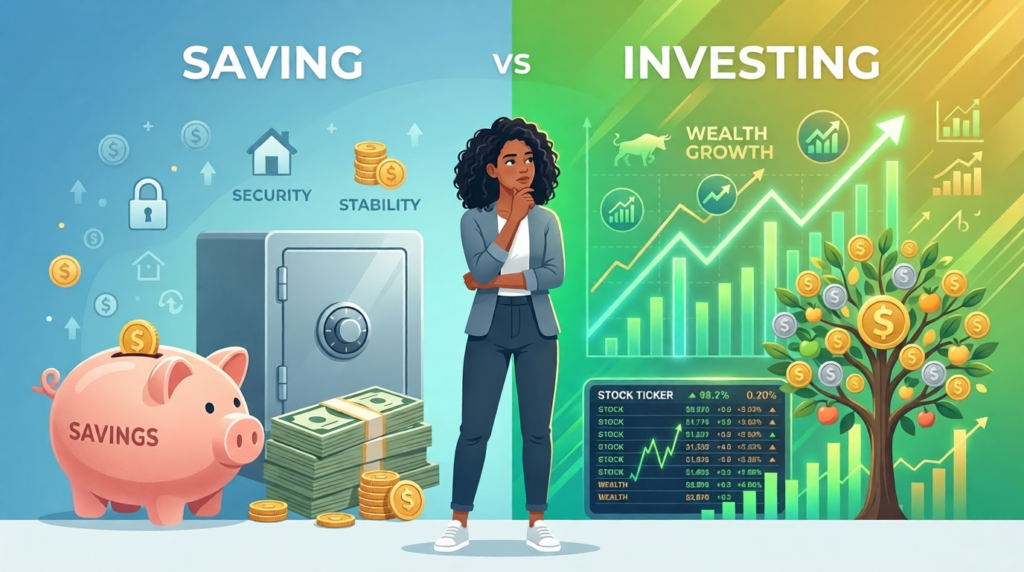
If you’ve ever wondered whether you should be saving more money or investing it instead, you’re not alone. Many people use the terms saving and investing interchangeably, assuming they mean the same thing. In reality, they serve very different purposes and misunderstanding that difference can have a significant impact on your financial future.
At first glance, both saving and investing involve setting aside money for later use. But the way that money grows, the level of risk involved, and the purpose behind each approach are fundamentally different. Failing to recognize these distinctions can lead to missed opportunities, financial stress, or even long-term setbacks.
Understanding the difference matters because your financial life depends on making the right choices at the right time. Whether you’re preparing for emergencies, planning a major purchase, or building wealth for retirement, knowing when to save and when to invest can make all the difference.
In this article, we’ll break down the key differences between saving and investing, explain how each works, and show you how to use both strategies together. The bottom line: saving and investing serve different purposes, and both are essential for building a strong, balanced financial strategy.
What Is Saving?
A. Definition
Saving is the process of setting aside money in a safe and easily accessible place for future use. It typically involves putting your money into accounts where the risk of loss is extremely low.
The primary goal of saving isn’t to grow your wealth significantly it’s to preserve it and ensure it’s available when you need it.
B. Common Saving Vehicles
There are several common places where people keep their savings:
- Savings accounts: These are offered by banks and credit unions and allow you to earn a small amount of interest while keeping your money accessible.
- Checking accounts: While primarily used for daily transactions, they can also hold saved funds temporarily.
- Money market accounts: These often offer slightly higher interest rates than savings accounts while maintaining liquidity.
- Certificates of deposit (CDs): These lock your money away for a fixed period in exchange for a higher interest rate.
C. Key Characteristics
Saving has several defining traits:
- Low risk: Your money is generally protected, especially in insured accounts.
- High liquidity: You can access your funds quickly, often instantly.
- Lower returns: Interest rates are typically modest, meaning your money grows slowly.
D. Primary Goals of Saving
Saving plays a crucial role in financial stability. Common goals include:
- Emergency funds: Covering unexpected expenses like medical bills or car repairs.
- Short-term goals: Paying for a vacation, rent, or a new appliance.
- Peace of mind: Knowing you have a financial cushion reduces stress and uncertainty.
What Is Investing?
A. Definition
Investing involves using your money to purchase assets with the expectation that they will generate returns over time. Unlike saving, investing focuses on growing your wealth rather than simply preserving it.
B. Common Investment Types
There are many ways to invest, including:
- Stocks: Shares of ownership in a company.
- Bonds: Loans you give to governments or corporations in exchange for interest payments.
- Mutual funds: Pools of money from multiple investors used to buy a diversified portfolio.
- ETFs (Exchange-Traded Funds): Similar to mutual funds but traded like stocks.
- Real estate: Property investments that can generate rental income or appreciate in value.
C. Key Characteristics
Investing differs from saving in several important ways:
- Higher risk: Market fluctuations can cause your investments to rise or fall in value.
- Potential for higher returns: Over time, investments can significantly outpace savings.
- Longer time horizon: Investing is typically geared toward long-term goals.
D. Primary Goals of Investing
Investing is essential for:
- Wealth growth: Building assets over time.
- Retirement planning: Ensuring financial independence later in life.
- Beating inflation: Maintaining and increasing your purchasing power.
Key Differences Between Saving and Investing
Understanding how saving and investing compare side by side can help clarify when to use each.
A. Risk Level
- Saving: Minimal risk. Your principal is generally safe.
- Investing: Risk varies depending on the asset, but losses are possible.
B. Returns
- Saving: Predictable but modest returns.
- Investing: Higher potential returns, but less certainty.
C. Time Horizon
- Saving: Best for short-term needs.
- Investing: Ideal for medium to long-term goals.
D. Liquidity
- Saving: Highly liquid money is easy to access.
- Investing: Some investments may take time to convert into cash.
E. Purpose
- Saving: Focused on protection and stability.
- Investing: Focused on growth and wealth accumulation.
The Impact of Inflation
Inflation is the gradual increase in prices over time, which reduces the purchasing power of money. In simple terms, the same amount of money buys less in the future than it does today.
This is where saving alone can fall short.
If your money is sitting in a low interest savings account, it may not grow fast enough to keep up with inflation. For example, if inflation is 3% per year but your savings account earns only 1%, you’re effectively losing purchasing power.
Investing helps combat this issue by offering the potential for higher returns. Over the long term, investments like stocks and real estate have historically outpaced inflation, allowing your money to grow in real terms.
When to Save vs When to Invest
A. When to Prioritize Saving
Saving should come first in several situations:
- Building an emergency fund: Aim for 3–6 months of living expenses.
- Short-term expenses: If you’ll need the money within a few years, saving is safer.
- Low risk tolerance: If market fluctuations make you uncomfortable, prioritize saving.
B. When to Prioritize Investing
Once your financial foundation is stable, investing becomes more important:
- After establishing emergency savings: This reduces the risk of needing to sell investments during a downturn.
- Long-term goals: Retirement, education, or buying a home in the distant future.
- Higher risk tolerance: If you can handle market ups and downs, investing offers greater rewards.
How to Balance Saving and Investing
A. The Importance of Both
Saving and investing are not mutually exclusive. In fact, relying on only one can limit your financial potential. A well-rounded strategy includes both.
B. Suggested Strategy
A common approach is:
- Build an emergency fund through saving.
- Pay off high interest debt.
- Allocate additional money toward investments.
C. Example Allocation Models
- Conservative approach: Higher percentage in savings, lower in investments.
- Aggressive approach: Minimal savings beyond emergencies, more invested.
- Age-based strategy: Younger individuals invest more heavily, while older individuals shift toward saving and preserving wealth.
Common Mistakes to Avoid
Even with good intentions, people often make avoidable mistakes:
- Keeping too much in savings: You may miss out on growth opportunities.
- Investing without an emergency fund: This can force you to sell at a loss during emergencies.
- Ignoring risk tolerance: Taking on too much risk can lead to panic decisions.
- Trying to time the market: Predicting market movements is extremely difficult.
- Lack of diversification: Putting all your money in one investment increases risk.
Practical Steps to Get Started
A. For Saving
- Open a high-yield savings account to maximize interest.
- Automate contributions so you consistently build your savings.
- Set clear, specific goals to stay motivated.
B. For Investing
- Start with retirement accounts like a 401(k) or IRA.
- Use index funds or ETFs for broad diversification.
- Invest consistently using strategies like dollar-cost averaging.
Real Life Example Scenario
Let’s compare two individuals: Alex and Jordan.
Alex only saves money.
He puts $500 per month into a savings account earning 1% interest. Over 30 years, he accumulates a significant amount but the growth is slow, and inflation reduces the real value of his savings.
Jordan saves and invests.
She builds an emergency fund first, then invests $500 per month into a diversified portfolio earning an average of 7% annually. Over the same 30 years, her investments grow substantially more due to compound interest.
The difference in outcomes can be dramatic often hundreds of thousands of dollars or more highlighting the power of investing alongside saving.
Conclusion
Saving and investing are both essential tools in your financial toolkit, but they serve very different purposes. Saving provides security, stability, and quick access to funds, while investing offers the potential for long-term growth and wealth accumulation.
Relying solely on saving can leave your money vulnerable to inflation, while jumping into investing without a safety net can expose you to unnecessary risk. The key is balance.
By understanding when to save and when to invest, you can build a strategy that supports both your short-term needs and long-term goals. Start by securing your financial foundation, then gradually shift toward growth through investing.
The most important step is to take action. Whether you begin by opening a savings account or making your first investment, every step you take brings you closer to financial confidence and independence.