
Imagine two people. One starts saving $200 a month at age 20 and stops at 30. The other starts saving the same amount at 30 and continues until retirement at 65. Surprisingly, the first person often ends up with more money despite investing for a much shorter time.
This isn’t magic. It’s the power of compound interest.
Often called the “eighth wonder of the world,” compound interest is one of the most powerful financial concepts you can understand. It quietly works in the background, turning small, consistent contributions into substantial wealth over time.
In simple terms, compound interest means you earn interest not only on your original money but also on the interest that money has already earned.
The core idea is this: small, consistent actions over time can produce disproportionately large results due to compounding. Whether you’re saving, investing, or even building habits, compounding rewards patience and consistency.
Understanding the Basics
A. Simple Interest vs. Compound Interest
Before diving deeper, it’s important to understand the difference between simple and compound interest.
Simple interest is calculated only on the original amount (the principal).
For example, if you invest $1,000 at 5% simple interest, you earn $50 every year—no more, no less.
Compound interest, on the other hand, is calculated on both:
- The original principal
- The accumulated interest over time
So, in year one, you earn interest on $1,000.
In year two, you earn interest on $1,050.
In year three, on $1,102.50 and so on.
The key difference is this: compound interest grows exponentially because you earn interest on your interest.
B. The Formula for Compound Interest
The standard formula is:
A = P(1 + r/n)^(nt)
Let’s break it down:
- A = Final amount (what your investment becomes)
- P = Principal (your starting amount)
- r = Annual interest rate (in decimal form)
- n = Number of times interest is compounded per year
- t = Time in years
In plain language:
This formula calculates how your money grows when interest is repeatedly added and begins earning its own interest.
Even if the formula looks intimidating, the takeaway is simple:
More time and higher rates lead to dramatically larger outcomes.
C. Compounding Frequency
Interest can be compounded at different intervals:
- Annually (once per year)
- Semi-annually (twice per year)
- Quarterly (four times per year)
- Monthly (12 times per year)
- Daily (365 times per year)
The more frequently interest is compounded, the faster your money grows.
For example, $1,000 at 5%:
- Compounded annually grows less than
- Compounded monthly
- Which grows slightly less than daily compounding
While the differences may seem small at first, over decades, they become meaningful.
The Time Factor: Why Starting Early Matters
A. The Exponential Nature of Growth
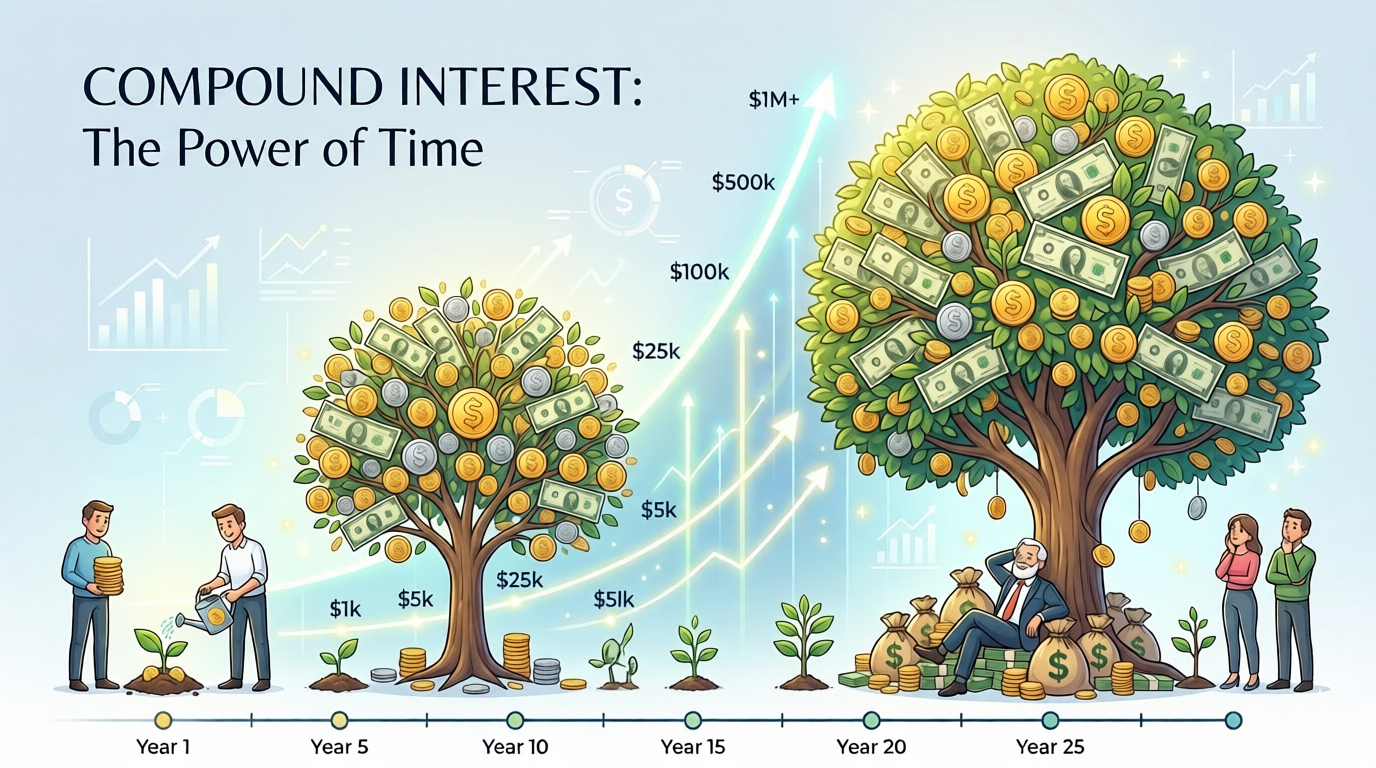
Compound interest doesn’t grow in a straight line it grows in a curve.
- Linear growth: Adds the same amount each year
- Exponential growth: Accelerates over time
In the early years, growth feels slow. But over time, it speeds up dramatically. This is why people often underestimate its power because the biggest gains come later.
B. Case Study: Early Investor vs. Late Investor
Let’s compare two individuals:
Person A (Early Starter):
- Starts at age 20
- Invests $200/month for 10 years
- Stops investing at 30
- Total invested: $24,000
Person B (Late Starter):
- Starts at age 30
- Invests $200/month until age 65
- Total invested: $84,000
Assuming a 7% return:
- Person A ends up with more money at retirement
- Person B invests far more but has less time to compound
This example shows that time matters more than total contribution.
C. The Cost of Delay
Every year you delay investing costs you more than just that year’s contribution.
You also lose:
- Years of compounding
- Growth on growth
- Momentum
This is known as opportunity cost.
Waiting even 5–10 years can result in tens or hundreds of thousands of dollars lost over a lifetime.
Real World Applications
A. Personal Finance
Compound interest plays a key role in everyday financial planning:
Savings accounts:
Even modest interest rates can grow emergency funds over time.
Retirement accounts:
401(k)s and IRAs rely heavily on compounding over decades.
Emergency funds:
While primarily for safety, they still benefit from gradual growth.
B. Investing
Compounding is most powerful when paired with investing:
Stocks and index funds:
Long-term market growth amplifies compounding.
Dividend reinvestment:
Dividends buy more shares, which generate more dividends.
Long-term strategies:
The longer you stay invested, the more compounding works in your favor.
Short-term trading often interrupts compounding, reducing its impact.
C. Debt (The Reverse Effect)
Compound interest isn’t always your friend.
Credit cards:
High interest rates compound quickly, making balances grow rapidly.
Student loans:
Interest accumulation can significantly increase total repayment.
When you owe money, compounding works against you turning small debts into large burdens.
Key Factors That Influence Compounding
A. Interest Rate
Higher interest rates accelerate growth.
For example:
- 5% vs. 10% doesn’t just double returns it can multiply outcomes over time.
However, higher returns often come with higher risk. Balancing risk and reward is crucial.
B. Time Horizon
Time is the most powerful factor in compounding.
Even a modest return over 30–40 years can outperform higher returns over shorter periods.
Patience isn’t optional it’s essential.
C. Consistency of Contributions
Regular contributions significantly boost results.
Monthly investing:
- Builds discipline
- Smooths market fluctuations
Dollar-cost averaging:
- Invests fixed amounts regularly
- Reduces the impact of market volatility
Consistency often matters more than timing.
D. Taxes and Fees
Compounding works best when uninterrupted.
Taxes:
- Reduce net returns
- Slow long-term growth
Fees:
- Even 1–2% annual fees can drastically reduce wealth over decades
Using tax-advantaged accounts and low-cost investments helps preserve compounding power.
Psychological and Behavioral Aspects
A. Delayed Gratification
Compounding rewards those who can delay immediate rewards.
Choosing to invest instead of spend:
- Builds long-term wealth
- Requires discipline
B. Discipline and Consistency
Automation is a powerful tool:
- Automatic transfers to savings
- Automatic investments
This removes emotional decision making.
Avoiding panic during market downturns is also critical. Emotional decisions often disrupt compounding.
C. Common Mistakes
- Trying to time the market: Missing key growth periods
- Withdrawing too early: Interrupts compounding
- Ignoring small contributions: Small amounts add up significantly over time
The biggest mistake is often inaction.
Illustrative Examples and Scenarios
$100/Month Over 30 Years
- Monthly investment: $100
- Time: 30 years
- Return: 8%
Result: Over $150,000
Total invested: $36,000
The majority of the final amount comes from interest, not contributions.
Lump Sum vs. Ongoing Contributions
- Lump sum benefits from immediate compounding
- Ongoing contributions build momentum over time
The best approach often combines both.
Impact of Different Interest Rates
$10,000 over 30 years:
- At 5% → ~$43,000
- At 8% → ~$100,000
- At 10% → ~$174,000
Small differences in rates create massive differences over time.
Beyond Finance: Compounding as a Life Principle
A. Habits and Skill Building
Daily improvements even small ones compound over time.
Reading 10 pages a day:
- Leads to dozens of books per year
- Builds knowledge exponentially
B. Health and Fitness
Small habits:
- Daily exercise
- Better nutrition
Over years, these produce major health outcomes.
C. Relationships and Career Growth
- Networking builds over time
- Reputation compounds through consistent behavior
Trust, like money, grows gradually but powerfully.
Strategies to Maximize Compound Interest
- Start as early as possible
- Reinvest earnings (dividends and interest)
- Increase contributions over time
- Minimize fees and taxes
- Stay invested long-term
- Use automation tools
The formula for success is simple but requires consistency.
Potential Risks and Limitations
Inflation
Reduces purchasing power over time.
Your returns must outpace inflation to grow real wealth.
Market Volatility
Short-term fluctuations can be unsettling, but long-term trends matter more.
Overestimating Returns
Assuming unrealistic returns can lead to poor planning.
Liquidity Constraints
Long-term investments may limit access to funds when needed.
Conclusion
Compound interest is one of the simplest yet most powerful tools for building wealth.
It doesn’t require:
- Perfect timing
- Large sums of money
- Complex strategies
It requires time, consistency, and patience.
The earlier you start, the more you benefit. The longer you stay invested, the more dramatic the results.
You don’t need to wait for the “perfect moment.” Even small amounts invested today can grow into something significant tomorrow.
In the end, compounding rewards patience not perfection.